
Ligament Injury Treatment: Recovery, Rehab & When Surgery Is Needed
When a Twisted Knee Turns Into a Bigger Problem
A sudden twist while playing football, an awkward landing after a jump, or simply missing a step on the stairs, ligament injuries often happen in the blink of an eye, yet their effects can linger for weeks or months if not managed correctly. Whether it is a mild sprain or a complete tear, understanding ligament injury treatment options early can make the difference between a full recovery and long-term joint instability.
In this guide, we break down what ligaments actually do, how doctors diagnose an injury, the difference between a tear and a fracture, and exactly when non-surgical rehab is enough versus when surgery becomes necessary. We also look at how specialists guide patients through safe, structured recovery.
What Is a Ligament Injury? Understanding the Basics
Ligaments are tough, fibrous bands of tissue that connect one bone to another, stabilizing joints and controlling the range of motion. The knee alone depends on four major ligaments (ACL, PCL, MCL, and LCL) working together with the knee joint bones, the femur, tibia, and patella, to allow smooth, controlled movement.
When a joint is forced beyond its normal range, through twisting, overstretching, or a direct blow, the ligament fibres can stretch, partially tear, or rupture completely. This is what we broadly call a ligament injury, and it is one of the most common reasons people visit an orthopedic clinic after sports activity, a fall, or a road accident.
Because the knee joint bones rely so heavily on ligament support for stability, even a minor injury here can affect walking, climbing stairs, or standing for long periods. If a fall or accident is involved, it is also worth understanding how ligament damage differs from a bone fracture, since both can present with similar swelling and pain but require very different treatment approaches.
What Causes Ligament Injuries? Common Triggers You Should Know
Ligament damage rarely happens without a reason. Some of the most frequent causes include:
- Sudden directional changes during sports like football, basketball, or badminton
- Awkward landings after a jump, common in athletes and dancers
- Road traffic accidents involving direct impact to the knee or ankle
- Slips and falls, especially on wet or uneven surfaces
- Repetitive strain from occupations or activities that overload a joint repeatedly
- Age-related tissue weakening, which reduces ligament elasticity over time
Interestingly, ongoing stiffness in the joints as we age can also raise injury risk. If you have noticed your joints feel tighter first thing in the day, it may be worth reading about morning joint stiffness and what it signals as an early warning sign.
Signs You Shouldn’t Ignore: Recognising Ligament Pain
Not every ache means a torn ligament, but certain symptoms of ligament pain should never be brushed aside. Watch for:
- A popping or snapping sound at the moment of injury
- Sudden, sharp pain followed by swelling within hours
- A feeling that the joint is loose, wobbly, or ‘giving way’
- Difficulty bearing weight on the affected leg
- Restricted range of motion or stiffness the next morning
- Bruising that spreads around the joint over 24 to 48 hours
Persistent ligament pain that does not settle with rest, ice, and elevation within two to three days is a clear signal to seek a professional orthopedic evaluation rather than waiting it out.
Ligament Tear vs Ligament Fracture: What’s the Real Difference?
Patients often use the terms interchangeably, but a ligament fracture and a ligament tear are not the same injury. A ligament tear involves damage to the soft, fibrous connective tissue itself, ranging from micro-tears to a complete rupture. A fracture, on the other hand, refers to a break in the bone, sometimes occurring at the exact point where the ligament attaches, known as an avulsion fracture.
In some accident cases, both injuries occur together, a torn ligament alongside a small bone fragment pulled away at the attachment site. This is why accurate imaging is essential before starting ligament tear treatment, and why any suspected bone fracture should always be ruled out with an X-ray first.
How to Test for Knee Ligament Injury: What Happens at the Clinic
Wondering how to test for knee ligament injury properly? A thorough evaluation typically combines a physical examination with imaging. At Prakash Hospital, the diagnostic process usually includes:
1. Clinical Examination
The doctor checks for swelling, tenderness, joint stability, and range of motion. Specific manual tests, such as the Lachman test, anterior drawer test, and varus/valgus stress test, help identify which ligament is affected and how severely.
2. Imaging Tests
- X-ray: to rule out an associated ligament fracture or bone damage
- MRI scan: the gold standard for visualising soft tissue and confirming the grade of the tear
- Ultrasound: sometimes used for quick assessment of ligament and tendon integrity
Combining a hands-on examination with the right imaging ensures the treatment plan is based on the actual severity of the injury, not just guesswork.
Grades of Ligament Injury at a Glance
Doctors classify ligament injuries into three grades based on severity, which directly guides the treatment approach:
| Grade | Description | Common Symptoms | Typical Treatment |
| Grade I (Mild) | Slight stretching of ligament fibres, no instability | Mild pain, minimal swelling | RICE therapy, bracing, physiotherapy |
| Grade II (Moderate) | Partial tear, some joint looseness | Moderate pain, swelling, mild instability | Bracing, structured rehab, gradual loading |
| Grade III (Severe) | Complete rupture, significant instability | Severe pain, swelling, joint gives way | Often surgical reconstruction plus rehab |
Ligament Injury Treatment: From First Aid to Full Recovery
The right ligament injury treatment plan depends entirely on the grade of injury, the specific ligament involved, and the patient’s activity goals. Broadly, treatment unfolds in stages.
Immediate Care (First 48–72 Hours)
- Rest: avoid weight-bearing on the injured joint
- Ice: apply for 15–20 minutes every few hours to control swelling
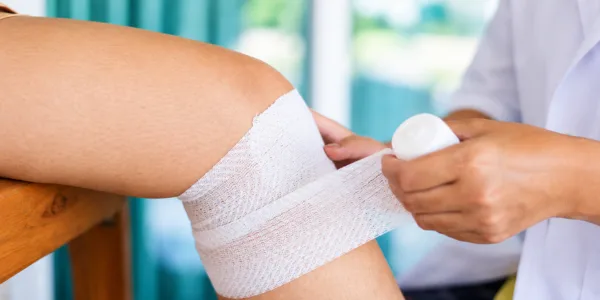
- Compression: use an elastic bandage or brace for support
- Elevation: keep the limb raised above heart level
This RICE approach is the foundation of early ligament pain management, regardless of the grade of injury, and helps limit further internal bleeding and swelling around the joint.
Ligament Tear Treatment: Non-Surgical Options
For Grade I and many Grade II injuries, ligament tear treatment is largely non-surgical and includes:
- Bracing or splinting to protect the joint while healing
- Physiotherapy to restore strength, flexibility, and balance
- Pain management with anti-inflammatory medication as advised by your doctor
- Gradual return to activity guided by a rehabilitation specialist
When Is Surgery Really Needed?
Surgery is not the default answer for every ligament injury, but it becomes necessary in specific situations, including:
- Complete (Grade III) ligament rupture, especially of the ACL, in active or young individuals
- Persistent joint instability that does not improve with rehabilitation
- Combined injuries, such as a ligament tear alongside a ligament fracture or meniscus damage
- Failure of conservative treatment after several weeks
- Patients who wish to return to competitive sport or physically demanding work
Surgical options typically involve arthroscopic ligament reconstruction, where the damaged ligament is repaired or replaced using a graft. The consulting team at Prakash Hospital’s orthopedic department evaluates each case individually, since rushing into surgery, or delaying it unnecessarily, can both affect long-term joint health.
Recovery Timeline: What to Expect Week by Week
Recovery speed varies by injury grade and whether surgery was performed, but a general roadmap looks like this:
- Weeks 1–2: Swelling control, gentle range-of-motion exercises, protected weight-bearing
- Weeks 3–6: Progressive strengthening, balance training, and light functional movements
- Weeks 7–12: Sport-specific or activity-specific rehabilitation begins
- 3–9 months (post-surgical cases): Gradual return to full activity, guided by strength and stability testing
Consistent physiotherapy is often the single biggest factor separating a smooth recovery from a prolonged one, regardless of whether the injury was treated surgically or conservatively.
Physiotherapy and Rehab: The Stage Most People Rush Through
Many patients assume that once pain and swelling settle, the injury is healed. In reality, the ligament may have regained some strength while the surrounding muscles remain weak and the joint’s balance reflexes are still impaired. Skipping structured rehab is one of the most common reasons for re-injury.
- Range-of-motion exercises: gentle bending and straightening to prevent stiffness
- Strengthening work: quadriceps, hamstring, and calf exercises to support the joint
- Balance and proprioception training: using wobble boards or single-leg stands to retrain joint awareness
- Sport-specific drills: gradual reintroduction of running, cutting, and jumping movements
A physiotherapist typically progresses patients through these stages only once specific strength and stability benchmarks are met, rather than following a fixed calendar. This individualised pacing is what allows most people to return to their normal activities, and even competitive sport, with confidence.
Common Myths About Ligament Injury Treatment
- Myth: “If I can still walk, it’s not serious.” Even a complete ligament tear can allow some walking, especially once initial pain subsides.
- Myth: “Rest alone will fix it.” Prolonged rest without rehab often leads to muscle weakness and residual instability.
- Myth: “Surgery guarantees a full recovery.” Surgical success still depends heavily on disciplined post-operative rehabilitation.
- Myth: “Ligament pain always means a tear.” Mild strains, tendon irritation, or even referred joint stiffness can mimic ligament pain without an actual tear.
Why Choose Prakash Hospital for Ligament Care
Effective ligament injury treatment depends on accurate diagnosis, personalized planning, and consistent follow-up. At Prakash Hospital, patients are assessed by an experienced orthopedic team, with care overseen by Dr. Mayank Chauhan, known for a practical, patient-first approach to musculoskeletal injuries in Greater Noida.
From the first physical examination to imaging, non-surgical rehab, or advanced arthroscopic surgery when required, the focus remains on restoring joint stability safely, without unnecessary interventions.
Simple Habits to Protect Your Ligaments Long-Term
- Warm up properly before exercise or sport
- Strengthen the muscles surrounding major joints, especially the knees
- Wear appropriate, well-fitted footwear for your activity
- Avoid sudden increases in training intensity or duration
- Address joint stiffness or minor pain early instead of ignoring it
Frequently Asked Questions About Ligament Injury Treatment
1. How long does ligament injury treatment usually take?
Mild sprains often improve within 2 to 4 weeks, while moderate to severe tears can take 3 to 9 months, particularly if surgery is involved.
2. Can a torn ligament heal without surgery?
Yes, many Grade I and Grade II tears heal well with rest, bracing, and structured physiotherapy. Grade III ruptures often need surgical evaluation, especially in active individuals.
3. How to test for knee ligament injury at home?
While self-checks like noticing instability, swelling, or a popping sensation can raise suspicion, a confirmed diagnosis always requires a clinical examination and imaging such as an MRI, so a professional assessment is essential.
4. Is ligament pain the same as arthritis pain?
No. Ligament pain typically follows an injury and is localised with swelling, while arthritis pain develops gradually and is linked to joint wear over time.
5. What is the difference between a ligament tear and a ligament fracture?
A ligament tear damages soft connective tissue, while a ligament fracture involves an actual break in the bone, sometimes at the point where the ligament attaches.
6. When should I see a doctor for ligament pain?
If pain, swelling, or instability persists beyond 48–72 hours, or if you cannot bear weight on the joint, it is time to consult an orthopedic specialist.
Conclusion: Don’t Ignore the Warning Signs
Ligament injuries range from mild sprains to complete ruptures, and the right response at the right stage matters enormously. Early diagnosis, appropriate ligament injury treatment, and a disciplined rehabilitation plan can help most patients regain full function, while surgery remains a targeted solution reserved for genuine instability or complete tears.
If you are dealing with persistent knee pain, swelling, or a suspected ligament injury, consult the orthopedic specialists at Prakash Hospital or book a consultation with Dr. Mayank Chauhan for a personalized evaluation and recovery plan.

- Hyperpigmentation Vitamin B12 Deficiency - October 6, 2026
- Forehead Pimples Reason - October 3, 2026
- Baby Eczema - September 30, 2026

1 Comment
Comments are closed.